Interaction Logs as Training Signals for Controllable Visual Merchandising Synthesis Under Sparse Editorial Feedback and Caption Evidence
- Authors
-
-
Fahad Iqbal
Department of Computer Science, Mir Chakar Khan Rind University, Sibi Road, Dera Ghazi Khan 32200, Punjab, Pakistan
Author
-
Zeeshan Ali
Department of Information Technology, University of Gwadar, Airport Road, Gwadar 91200, Balochistan, Pakistan
Author
-
- Abstract
-
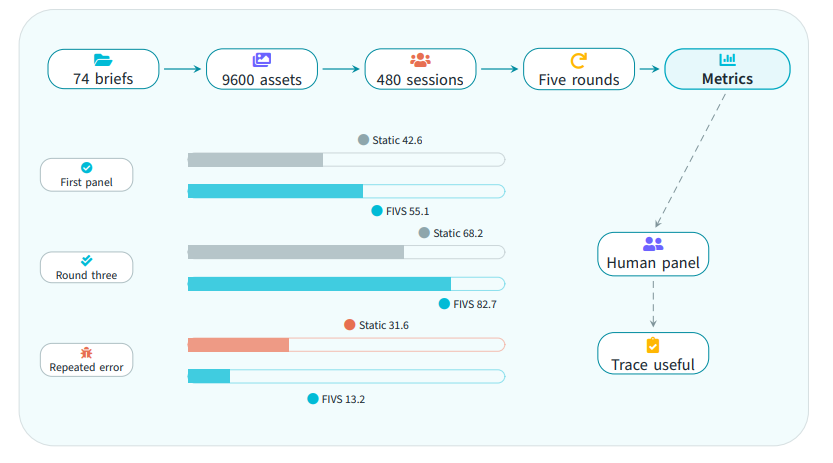
Synthetic merchandising imagery is increasingly produced through systems that join visual generation, textual description, and human review. A central difficulty is that editorial approval rarely arrives as dense supervision; reviewers usually provide short approvals, rejections, or brief comments after seeing complete candidate assets. This paper proposes a feedback-indexed synthesis framework that treats those sparse review traces as structured training signals rather than as informal post hoc notes. The method builds a caption evidence graph from generated image descriptions, reviewer actions, and localized visual attributes, then trains a preference-calibrated controller that changes sampling behavior without retraining the base image generator. In a simulated deployment study containing 9,600 generated merchandising assets, 480 reviewer sessions, and 74 product-context briefs, the proposed method increased first-panel acceptance from 42.6% to 55.1% over a non-adaptive generation workflow. It also reduced repeated rejection caused by missing environmental cues by 18.4% and lowered product-adjacent artifact reports by 9.7\%. Gains were strongest when reviewer feedback contained short natural-language reasons rather than binary approval alone. The analysis shows that sparse editorial decisions can be transformed into useful control signals when they are attached to explicit caption evidence and uncertainty-aware sampling rules. The method does not remove the need for human review, and it performs less reliably when reviewers disagree about visual direction. Still, the results indicate that lightweight feedback modeling can improve iterative visual production where fully labeled datasets are unavailable.
- References
- Cover Image
-
- Downloads
- Published
- 2026-04-07
- Section
- Articles
- License
-
Copyright (c) 2026 authors

This work is licensed under a Creative Commons Attribution-NonCommercial-NoDerivatives 4.0 International License.
